The 'Lunch Break' Outreach Strategy: Landing Your First 10 Users Without Ad Spend
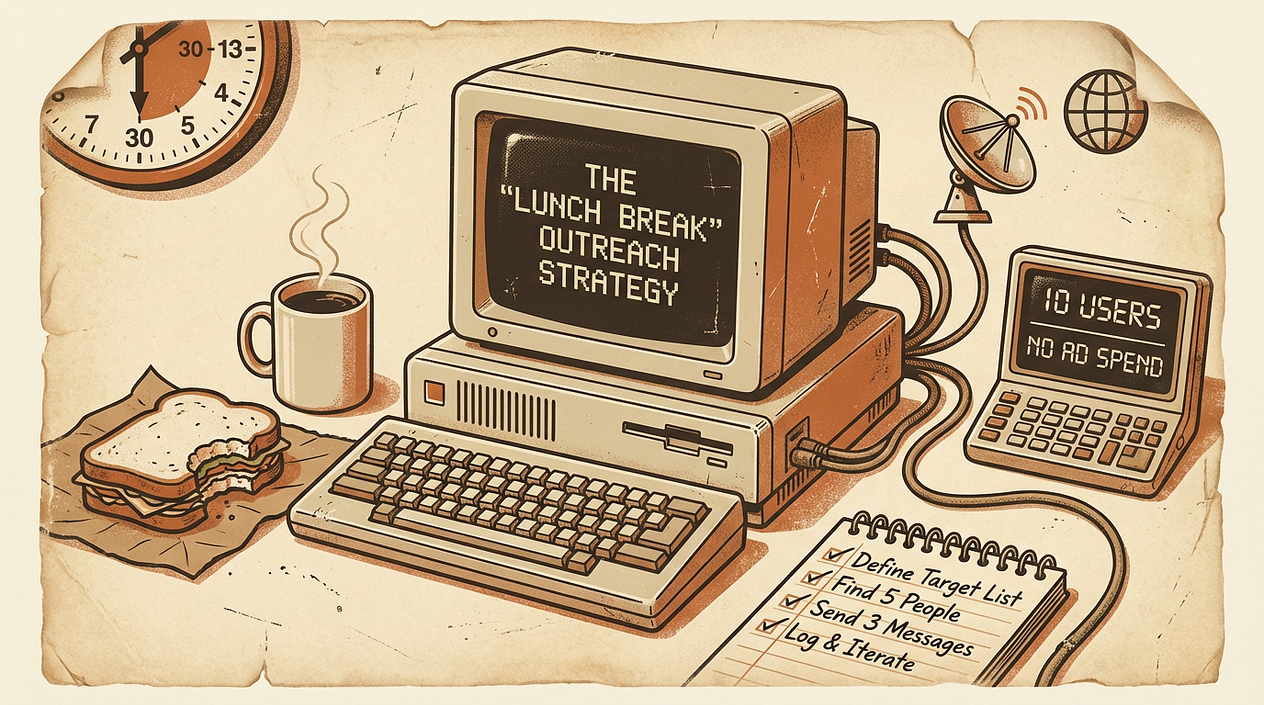
You’ve got a side project that works… at least on your laptop. Then reality hits: no users, no feedback, no momentum. And since you’re building between standups, laundry, and “just one more episode,” you don’t have time for a 47-step growth strategy.
That’s where the Lunch Break Outreach Strategy wins. It’s not glamorous. It’s not scalable. It’s the point.
Early acquisition is mostly about manual hustle and learning—HubSpot calls the 0–10 phase “unscalable” by design, because you’re still finding your message and your people (HubSpot).
Why lunch-break outreach works (when ads don’t)
Paid ads are a multiplier. If your positioning is fuzzy and your landing page is doing interpretive dance instead of converting, ads just help you lose money faster.
Lunch-break outreach forces three good behaviors:
- You pick a narrow ICP (ideal customer profile) instead of “anyone who breathes.”
- You talk to real humans in their actual context.
- You collect qualitative feedback to fix your funnel and messaging (a pillar of sustainable acquisition, alongside social proof and content/SEO) (Contentsquare).
Also, personal outreach can convert surprisingly well in niche communities when it’s value-first—conversion rates can be far higher than broad, cold traffic (Crunchbase).
The 30-minute routine (do this for 10 workdays)
Here’s the playbook. One lunch break. No heroics.
Minute 0–5: Define today’s target list
Pick one slice of your ICP. Example: “Freelance designers who send proposals weekly” or “Shopify store owners doing email marketing solo.”
Minute 5–15: Find 5 right-fit people
Sources that don’t require a budget:
- LinkedIn search (role + niche)
- Relevant Slack/Discord communities
- Reddit threads where your problem is actively discussed
Minute 15–25: Send 3 personalized messages
Use a simple structure:
- One specific observation
- One-line value proposition
- Low-friction ask
Template:
Hey {Name} — saw you mentioned {specific pain} in {place}. I’m building {tool} to help {ICP} {outcome} without {annoying thing}. If you’re open, I’d love 10 minutes to see how you handle {pain} today. If it’s a fit, I can also set you up with early access.
Minute 25–30: Log + iterate
Track in a tiny sheet: Name, channel, pain mention, message version, response, next step.
Do this for 10 weekdays and you’ll send ~30 high-quality pings—enough to learn what lands.
Three realistic examples
-
Micro-SaaS for meeting notes (B2B): Target engineering managers posting about “too many status updates.” Offer: “I’ll set you up and tune it to your weekly cadence.” Your first 10 users will mostly come from conversations, not SEO.
-
Job-hunt tracker for students (B2C): Message people asking for “application spreadsheet templates” in student communities. Offer a free import of their spreadsheet—instant value, minimal persuasion.
-
Dev tool / open-source add-on: Find GitHub issues where people complain about a workflow. Message maintainers/users with a demo GIF and ask, “Want to test this on your repo?” Bonus: those users create public proof.
Actionable takeaways
- Time-box acquisition: 30 minutes/day beats a “someday I’ll do marketing” plan.
- Aim for conversations, not clicks: Your first 10 users are a research project with a receipt.
- Personalize the first line, not the whole novel: Specificity earns replies.
- Turn feedback into assets: Save good quotes, screenshots, and outcomes—your future social proof starts here.
Do lunch-break outreach for two weeks. If you can’t get replies, your target is wrong or your value prop is unclear. That’s not failure—that’s your next engineering task.
 Share on Reddit