The 'Profitable Pivot': Engineering Your Side Project for a 2026 Exit
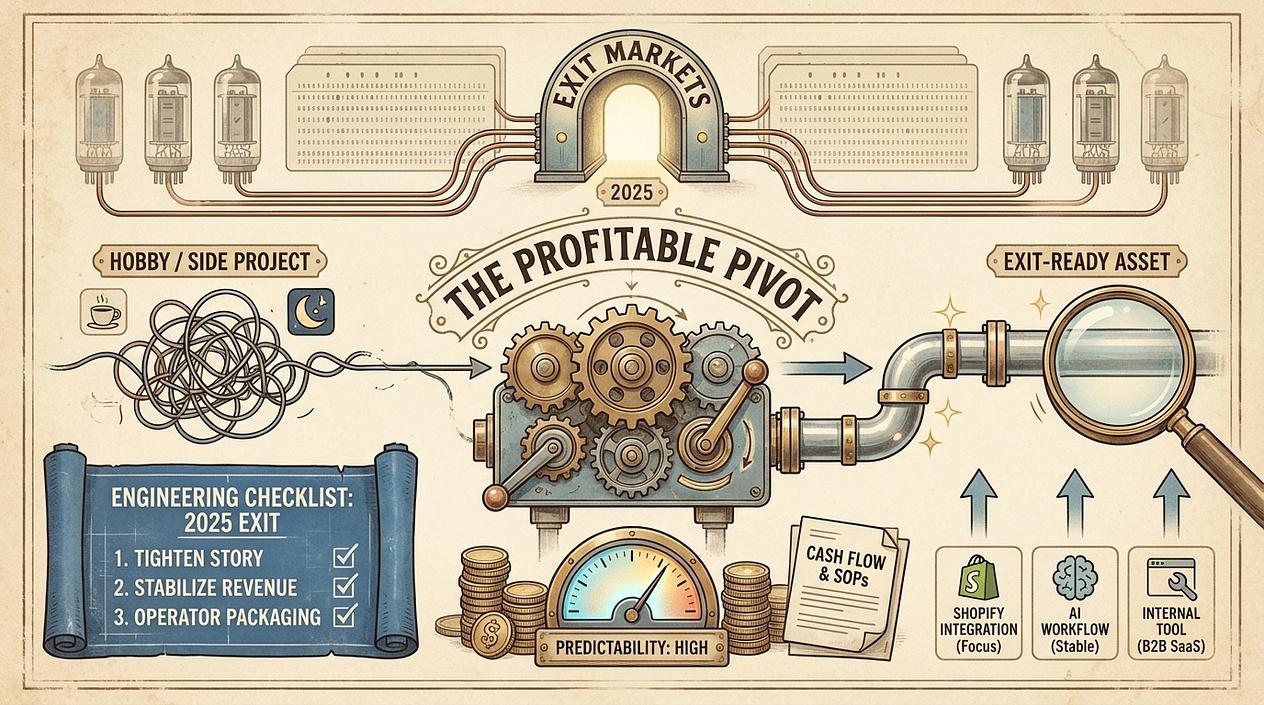
You started your side project to scratch an itch—maybe to automate a task at work, or to make a small recurring income stream. Then something shifts: the app is “working,” but it’s messy, hard to maintain after your 9–5, and you’re not sure whether it’s a hobby, a business, or a sellable asset.
That’s where the profitable pivot comes in: not a dramatic reinvention, but an engineering-led shift that makes your side project easier to run, easier to grow, and—importantly in 2026—easier to buy.
Micro-SaaS acquisition markets have matured, with buyers scanning marketplaces like Acquire.com for small, profitable tools that can be absorbed into existing portfolios. Many of the fastest exits are not about “the next big thing,” but about clear cash flow, low churn, and low operational risk—often in razor-thin niches and lean teams (Flowjam).
Why “exit-ready” matters more in 2026
A side project built around evenings and weekends has a built-in constraint: your time. Exit readiness is about shifting value from you doing the work to the product and process doing the work.
Two trends make this especially relevant:
- Buyers are paying for predictability. Micro-SaaS businesses can be highly attractive because margins can be strong and operations can be lean (Flowjam). Predictable MRR and documented operations increase confidence.
- Economic uncertainty rewards resilience. If early 2026 is bumpier (as some recession-window commentary suggests), buyers may favor cash-flowing assets and founders may want more financial optionality (The Industry Leaders).
This doesn’t mean you should “build to flip.” It means: if you might sell, design so you can sell.
The Profitable Pivot: a practical, engineering-first checklist
Think of exit readiness as three layers you can implement without quitting your job.
1) Tighten the business story: one ICP, one core job-to-be-done
Buyers don’t want a product that does five things “kind of.” They want a tool that solves one expensive, frequent problem for a specific customer.
- Rewrite your positioning in one sentence: “I help X do Y without Z.”
- Cut or de-emphasize features that attract support-heavy edge cases.
- Price like a painkiller when the value is clear (time saved, revenue protected, compliance risk reduced).
This aligns with the broader indie market shift away from “ship more” and toward intentional sequencing—foundation, understanding, messaging, then execution (Indie Hackers).
2) Stabilize revenue quality: reduce churn and de-risk concentration
Valuations for small SaaS often resemble a multiple of annual profit or seller discretionary earnings, and that multiple is heavily influenced by risk. Two common risk flags are high churn and customer concentration.
Focus on:
- Churn control: instrument activation metrics, improve onboarding, and remove sharp edges causing cancellations.
- Customer concentration: if one customer is >20–30% of revenue, diversify before marketing the business.
- Clean MRR reporting: consistent Stripe metrics, clear refund policy, and monthly cohort snapshots.
3) Make it run without you: “operator packaging”
Your goal is to turn late-night heroics into boring checklists.
- Document support flows (templates, macros, escalation rules).
- Replace manual tasks with scripts (billing retries, failed webhooks, backups).
- Standardize deployment and incident response.
- Maintain a simple ops folder: architecture diagram, env setup, key vendors, top 10 support issues.
When a buyer sees that the product is maintainable by someone else, your “bus factor” risk drops—and value rises.
3 realistic exit-ready pivots (without rebuilding everything)
- The Shopify/marketplace integration tool If you built an integration (Shopify, Notion, Slack), the pivot is often narrowing: pick one persona (e.g., “small DTC brands running weekly drops”), remove general-purpose settings, and create two opinionated workflows. This can lower support and improve conversion—two metrics buyers inspect.
- The AI wrapper that becomes a workflow product Many “AI wrappers” get attention, but churn when novelty fades. The pivot is adding the unsexy parts: saved templates, audit logs, role-based access, and a clear “before/after” outcome. Buyers on micro-SaaS marketplaces routinely favor stable workflow tools over fragile demos (Flowjam).
- The internal tool that becomes a niche B2B SaaS If your side project started as an internal script, the pivot is packaging: permissions, billing, and onboarding. Keep the feature set small, but make the experience self-serve. Even modest MRR can be attractive if margins are high and the handoff is clean.
Actionable takeaways (what to do this month)
- Write your “buyer memo” in one page: what it does, who buys, pricing, churn, and the one growth channel that works.
- Reduce one major risk: either customer concentration, churn, or undocumented ops—pick the biggest red flag and fix it.
- Create an exit-ready data room: Stripe exports, P&L, analytics screenshots, codebase overview, vendor list, and SOPs.
The profitable pivot is less about chasing a big valuation and more about building optionality. If you can make the business predictable, defensible, and transferable—while still balancing your 9–5—you’re not just building software. You’re building an asset.
 Share on Reddit